How Blockchain Is Redefining E-Commerce Transactions
24 August 2026
For the past two decades, e-commerce has run on a simple promise: trust the intermediary. Payment processors, banks, and marketplace platforms sit between buyer and seller, verifying identities, holding funds in escrow, and adjudicating disputes. This system works, but it is expensive, slow, and increasingly fragile. Every transaction carries a toll, every chargeback a penalty, and every cross-border payment a delay of days. Blockchain technology does not just tweak this model; it replaces the intermediary with a cryptographic consensus mechanism that changes who you trust, how you pay, and what happens when something goes wrong.
The shift is not about replacing your credit card with crypto. It is about rearchitecting the entire transaction layer so that trust is embedded in code rather than in a corporate balance sheet. To understand why this matters, you need to look at the real pain points of modern e-commerce, then examine how blockchain addresses them, and finally, where it still falls short.

The Hidden Costs of the Intermediary Economy
Every online purchase you make passes through at least three parties: the merchant's bank, the card network (Visa, Mastercard), and your bank. Each charges a fee. The average interchange fee in the United States is around 2 percent, but for international transactions, currency conversion fees can push that to 4 or 5 percent. For small merchants operating on thin margins, that is the difference between profit and loss.But fees are only the visible cost. The invisible costs are worse. Chargebacks, for example, are a $100 billion problem globally. Fraudulent chargebacks cost merchants not just the product value but also the processing fee, the chargeback fee, and the labor to dispute them. And because the card networks favor the consumer in disputes, merchants often lose even when they are right.
Then there is settlement time. When you buy something online, the merchant does not receive the funds for two to three business days. For a small business with tight cash flow, that delay can be crippling. International sellers wait even longer, sometimes up to seven days, while correspondent banks process the transfer through multiple hops.
Blockchain eliminates the intermediary by allowing two parties to transact directly, with the network itself validating the transaction. The settlement time drops from days to seconds or minutes. The fee drops from 3 percent to a fraction of a cent for the network itself, though exchange and gas fees still apply. And chargebacks become impossible because transactions are final. That finality is both a blessing and a curse, as we will see.
Smart Contracts: The Escrow Agent That Never Sleeps
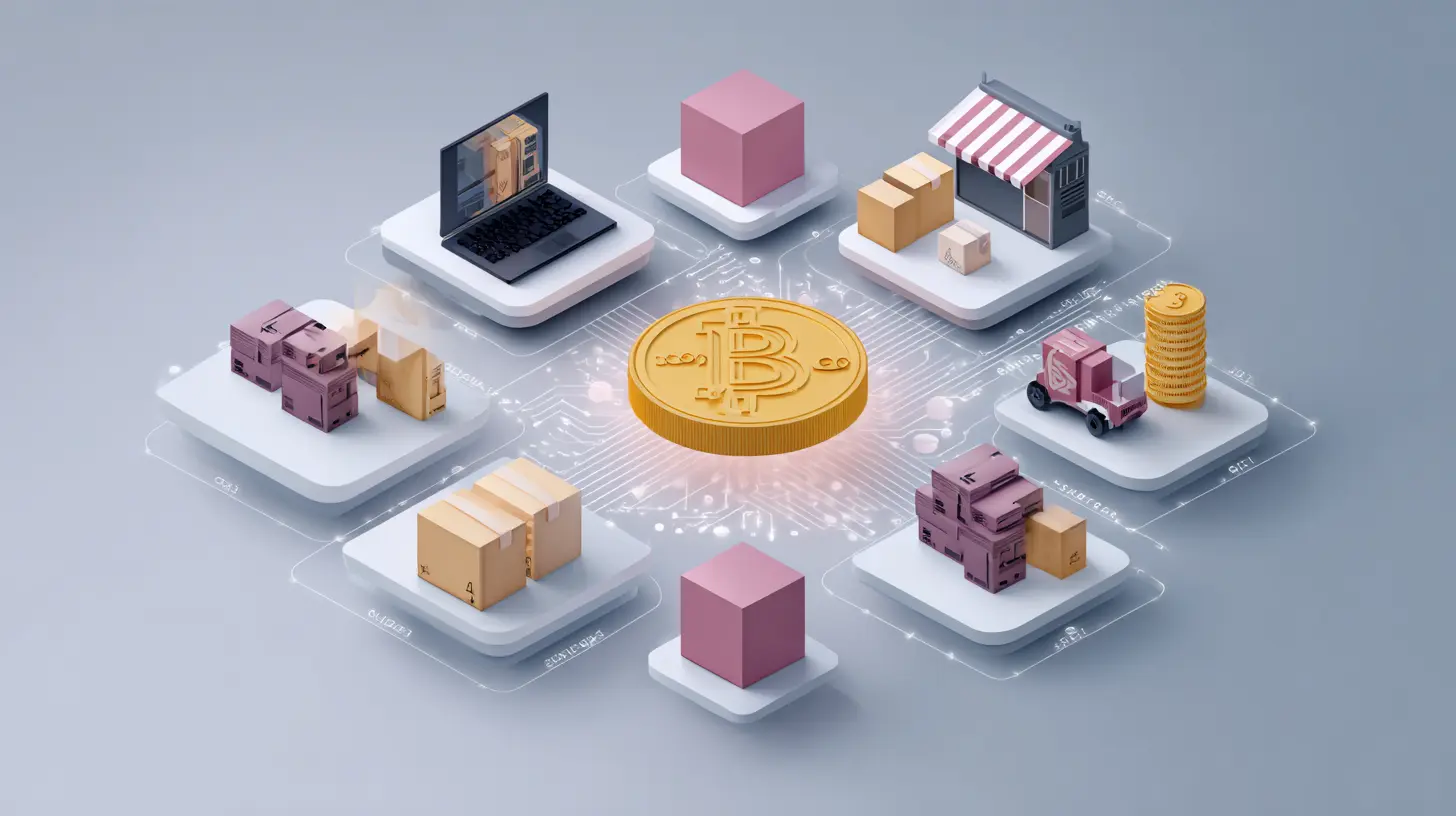
The most significant innovation blockchain brings to e-commerce is not the payment rail but the smart contract. A smart contract is a program stored on the blockchain that executes automatically when predetermined conditions are met. Think of it as a vending machine: you put in a coin, select a product, and the machine dispenses it. No human judgment, no dispute, no delay.In e-commerce, a smart contract can act as an escrow service. The buyer sends funds to the contract. The seller sees the funds locked and ships the goods. The buyer confirms receipt, and the contract releases the funds to the seller. If the buyer never confirms, the contract can automatically refund after a time lock, or trigger a third-party arbitration mechanism.
This is not a theoretical concept. Platforms like OpenBazaar, Particl, and the now-defunct BitMesh have built decentralized marketplaces on this principle. They remove the marketplace operator entirely. No one can censor a listing, freeze an account, or take a cut of every sale. The code is the platform.
The trade-off is that smart contracts are only as good as their inputs. A contract cannot know if a physical package actually arrived. It relies on an oracle, a trusted data feed, or a human arbiter to confirm delivery. This reintroduces a form of trust, though a narrower one. The contract does not trust a bank with your money; it trusts a specific oracle with a specific fact. That is a meaningful difference, but it is not the utopia that early proponents imagined.

Stablecoins and the Cross-Border Settlement Problem
One of the most practical applications of blockchain in e-commerce is the use of stablecoins for cross-border payments. A stablecoin is a cryptocurrency pegged to a stable asset, usually the US dollar. USDC, USDT, and DAI are the most common. They combine the speed and programmability of blockchain with the price stability of fiat currency.Consider a merchant in Vietnam selling handmade goods to a customer in Germany. The customer pays in euros. The merchant wants Vietnamese dong. Under the traditional system, the payment goes through a German bank, a correspondent bank, possibly a US clearing house, and then a Vietnamese bank. Each step adds a day and a fee. The final amount the merchant receives can be 5 to 7 percent less than the purchase price.
With a stablecoin, the German customer buys USDC on an exchange, sends it to the merchant's wallet, and the merchant converts it to dong on a local exchange. The entire process takes minutes. The fees are the exchange spreads, which are usually under 1 percent. The merchant also avoids the risk of currency fluctuation because the stablecoin holds its value during the brief conversion window.
This is not just for small cross-border sellers. Large platforms like Shopify have started integrating stablecoin payment options for merchants in emerging markets. The appeal is obvious: instant settlement, near-zero fees, and no chargeback risk. But there is a catch. The merchant must convert the stablecoin to local currency quickly to avoid any potential depeg risk. Stablecoins are not insured by the FDIC, and if the issuer collapses, the stablecoin can lose its peg. The TerraUSD collapse in 2022 is a stark reminder of what happens when a stablecoin fails.
The Myth of Irreversible Transactions
Blockchain transactions are final. Once a block is confirmed, the transaction cannot be undone. This is the core strength of the system, but it is also a major barrier to consumer adoption. In traditional e-commerce, the ability to reverse a payment is a consumer protection feature. If you never receive your order, you call your bank and dispute the charge. With blockchain, if you send funds to the wrong address, or if the seller never ships, you have no recourse.This has led to the development of escrow-based smart contracts, as mentioned earlier, but also to decentralized arbitration services. Projects like Kleros use a crowdsourced jury system to settle disputes. When a dispute arises, the smart contract freezes the funds and randomly selects a group of jurors who stake tokens to vote on the outcome. The majority vote wins, and the jurors are rewarded or penalized based on whether their vote aligns with the final outcome.
This system works for digital goods and services where the evidence is on-chain. But for physical goods, it requires the buyer to upload proof of non-delivery, which can be manipulated. A buyer could claim the package never arrived when it did, and without a trusted carrier's signature, the jury has no way to verify. This is why many blockchain e-commerce platforms still require a centralized logistics partner to provide delivery confirmations.
The practical advice here is to use blockchain payments for low-value, high-frequency transactions where the cost of dispute resolution exceeds the value of the item. For high-value purchases, stick with credit cards or use a hybrid model where the payment is on-chain but the dispute process is off-chain.
Tokenization of Loyalty and Rewards
Another area where blockchain is quietly reshaping e-commerce is loyalty programs. Traditional loyalty points are trapped in closed systems. You earn airline miles that expire, or store credit that can only be used at one retailer. Blockchain enables tokenized loyalty programs where points are issued as fungible tokens on a public ledger.These tokens can be traded, sold, or used across multiple merchants. A customer earns tokens at a coffee shop and spends them at a bookstore. The tokens have a transparent supply, so customers know exactly how many are in circulation, which prevents the devaluation that happens when companies quietly dilute their points.
The practical benefit for merchants is reduced liability. Traditional loyalty programs are recorded as a liability on the balance sheet because they represent future obligations. Tokenized programs can be structured so that the liability is transferred to the token holder. The merchant issues the tokens, sells them to a market maker, and the market maker holds the liability. This is a sophisticated financial structure, but it is being used by companies like Bakkt and BitPay to create interoperable reward ecosystems.
The downside is complexity. Customers do not want to manage a crypto wallet just to earn rewards. The user experience must be seamless, with the merchant handling the wallet infrastructure behind the scenes. If a customer loses their private key, they lose their rewards, and there is no customer service to recover them. This is a real usability problem that has not been fully solved.
Privacy and the Public Ledger Dilemma
One of the most misunderstood aspects of blockchain is privacy. Public blockchains are not private. Every transaction is visible to anyone. Your wallet address, transaction amount, and counterparties are all on the public record. While the address is pseudonymous, it is not anonymous. Chain analysis firms can often link addresses to real identities through exchange records and IP addresses.For e-commerce, this is a serious problem. Customers do not want their purchase history visible to the world. Merchants do not want their revenue and supplier relationships exposed. This has led to the development of privacy-focused blockchains like Monero, which hides transaction amounts and addresses, and zero-knowledge proof systems like Zcash, which allow transactions to be verified without revealing their contents.
But privacy coins face regulatory scrutiny. Exchanges in many jurisdictions have delisted Monero because it is untraceable and therefore associated with money laundering. The regulatory risk is a significant deterrent for legitimate merchants.
A more practical solution is the use of layer-2 protocols or sidechains that batch transactions and only settle the final state on the main chain. The Lightning Network for Bitcoin and the various rollups for Ethereum provide faster, cheaper, and more private transactions. The main chain only sees the opening and closing of a payment channel, not the individual transactions within it. This is how blockchain can scale to handle e-commerce volumes without exposing every purchase to the public.
The Regulatory Uncertainty That Slows Everything Down
No discussion of blockchain in e-commerce is complete without addressing regulation. The legal status of cryptocurrencies varies wildly by jurisdiction. In the US, the SEC has taken an enforcement-first approach, declaring many tokens to be securities. In the EU, the Markets in Crypto-Assets Regulation (MiCA) provides a comprehensive framework. In Asia, Japan and Singapore have embraced the technology with clear licensing regimes, while China has banned it outright.This patchwork creates real operational challenges for merchants. A store that accepts Bitcoin in the US must comply with state money transmitter laws, which require licenses and capital reserves. A store in Europe must perform KYC on customers above a certain transaction threshold. A store in China cannot accept crypto at all.
The practical advice is to use a payment processor that handles the regulatory compliance on your behalf. Services like BitPay, Coinbase Commerce, and Stripe's crypto payments convert the cryptocurrency to fiat instantly and handle the KYC/AML obligations. This way, the merchant accepts crypto payments but never holds the crypto, avoiding the regulatory burden. The trade-off is that you are back to trusting an intermediary, though a different one.
When Blockchain Should Not Be Used
It is important to be honest about the limitations. Blockchain is not a solution for every e-commerce problem. For domestic transactions in a stable currency with a functioning banking system, traditional payment rails are faster and cheaper. A credit card transaction settles in milliseconds at the point of sale, and the consumer pays zero fees. A blockchain transaction requires waiting for block confirmation, which can take seconds on Solana or minutes on Ethereum, and the gas fees can exceed the transaction value during network congestion.Blockchain also struggles with the human element. Customer service, returns, and refunds are inherently relational processes. A smart contract cannot listen to a frustrated customer explain that the product was damaged. It cannot issue a goodwill discount or offer a replacement. These are judgment calls that require human empathy.
The best use cases for blockchain in e-commerce are where the current system is broken: cross-border payments, high-value items that require trustless escrow, digital goods with instant delivery, and transactions where chargeback fraud is rampant. If you are selling physical goods domestically with a reliable supply chain, blockchain adds complexity without adding value.
The Hybrid Future: Not Either/Or But Both
The most likely future is not a wholesale replacement of the current system but a hybrid. Credit cards will remain for everyday purchases. Blockchain will carve out niches where its properties are uniquely valuable. We are already seeing this with platforms like MagicEden for NFTs, which are digital goods with clear ownership and instant delivery. We see it with luxury goods authentication, where a product's provenance is recorded on a blockchain, and the sale is settled with a smart contract.Some forward-thinking merchants are experimenting with a "pay with crypto, settle in fiat" model. The customer pays with USDC, the merchant receives dollars in their bank account the same day, and the merchant pays a flat fee of 1 percent instead of the 3 percent card fee. This gives the merchant the cost savings of blockchain without the volatility or regulatory exposure.
The key takeaway is that blockchain is not a magic wand. It is a tool with specific strengths and specific weaknesses. The merchants who succeed will be the ones who understand when to use it and when to stick with the old system. They will not force blockchain into every transaction. They will use it where it genuinely solves a problem, and they will hide the complexity from the customer.
The technology is still young. The infrastructure is still being built. But the direction is clear. Trust is moving from institutions to algorithms, and the transaction layer of e-commerce is being rebuilt around that shift. The merchants who adapt early will have a competitive advantage. Those who wait for the ecosystem to mature may find themselves locked out of the most efficient payment rails.
all images in this post were generated using AI tools
Category:
E Commerce TechnologyAuthor:

Jerry Graham
Discussion
rate this article
2 comments
Maren McKale
This article beautifully captures the transformative potential of blockchain in e-commerce. It's exciting to see how technology can enhance trust and efficiency.
September 24, 2026 at 3:47 AM
Jerry Graham
Thank you! I'm glad you found the article insightful. The potential of blockchain really is exciting for e-commerce.
Thea Bellamy
Blockchain is revolutionizing e-commerce by enhancing security, reducing fraud, and streamlining payments. Its decentralized nature allows for greater transparency and trust between buyers and sellers. As more businesses adopt this technology, we can expect a more efficient and reliable online shopping experience for everyone involved.
September 17, 2026 at 11:47 AM
Jerry Graham
I appreciate your insights. Blockchain's potential to boost security and trust in e-commerce is indeed transformative, paving the way for a better shopping experience. Exciting times ahead!